
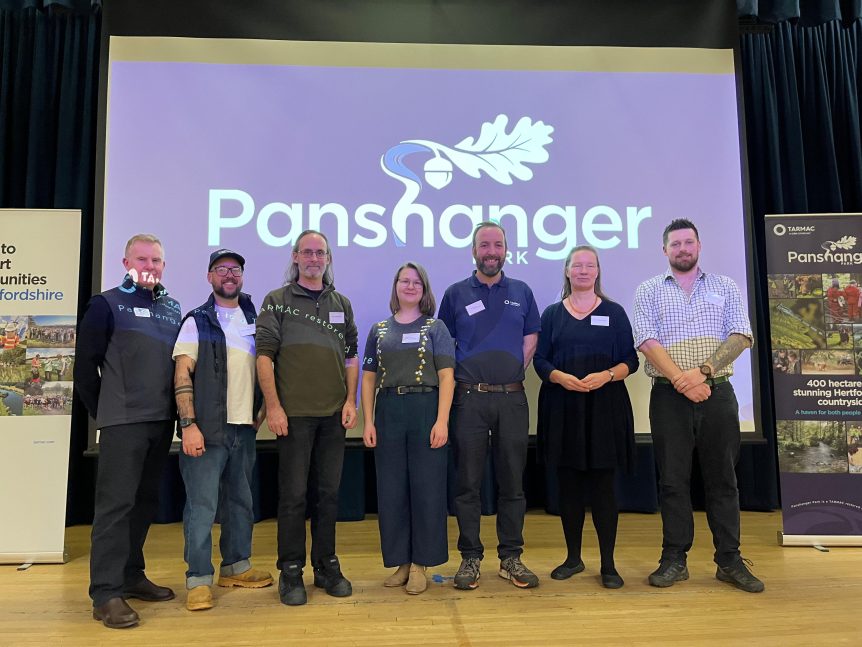
By Michelle Galloway, a dedicated Panshanger Park volunteer
Tim Hill from Herts and Middlesex Wildlife Trust opened the eighth Panshanger Park Conference by noting the launch of Hertfordshire’s Local Nature Recovery Strategy in December and the vital role of the Park in delivering this.
Alex Waetcher from HERC reported that a total of 3,282 species were recorded at Panshanger in the past year, including more than 300 species considered nationally rare or threatened. First time entries to the records included a stag beetle, a centipede, a hoverfly, a bee and a tree worm, as well as our newest resident plant, the scarce tufted sedge. Arachnid counts were also up, thanks to the efforts of some newly recruited spider surveyors. Alex noted that data collected by visitors to Panshanger had been vital in helping to develop the Local Nature Recovery Strategy for the area.
Alex also updated on a couple of recent changes to management of the Park’s records:
- Areas of the park now considered to be ancient woodland have increased, following a review of the criteria.
- The compartment map of Panshanger was amended to include former operational areas now open to the public. The number of sightings ascribable to a compartment has been increasing, reflecting the growing expertise of the surveyors.
Next Roy Woodward shared an update on dragons and damsels at Panshanger. HNHS is currently undertaking a six-year survey of these in Hertfordshire, following a previous survey between 2000 and 2005. While the first survey showed 19 species were breeding in the whole of Hertfordshire, more than 19 have now been recorded breeding at Panshanger alone. On a map showing the number of sightings every 2 square kilometres, Panshanger’s lakes were one of the most active areas in the county.
Roy shared photos of some of the most common residents, including Common Blues, Blue Emperors, Black Tailed Skimmers, Green Eyed (or Norfolk) Hawkers, Willow Emeralds, Red Eyes, Banded Demoiselles, Azures, Common Darters, and Four Spotted Chasers with their distinctive spots. Dragons and damsels love a wide range of habitats, including open water, small ponds, dense undergrowth, open stony ground, and lily pads. Attendees were encouraged to submit their own records of any sightings, perhaps whilst undertaking one of our guided walks on the dragon fly trail between May and September.
 Astrid Biddle from the Freshwater Habitats Trust gave an overview of the project to introduce scarce tufted sedge to Panshanger. This sedge was thought not to exist anywhere in England, but then a single population was found at Braughing in Hertfordshire in 2011. However the land was drying out and allowing other vegetation to take over and prohibiting the growth of new plants, so it seemed the sedge may soon disappear from the country after all.
Astrid’s team set about growing new plants for transplantation to four new sites across Hertfordshire, and last spring 375 sedges were planted at Panshanger with the aid of the Park volunteers. Despite a baking hot summer, 72% of the plants were still going in the autumn, and the first flowering has been recorded.
In the interval, there was a display of some stunning photography capturing the Park’s wildlife by Allan Burrows, our local expert William hosted a stall about the Park’s moths, and our volunteer Wendy spread the word about the importance of checking for hedgehogs before mowing and strimming in our gardens. We also heard about the Park’s connection with Mudlarks and the great work they do supporting local people with SEND.
Luke Allwright spoke about the Park’s veteran and ancient trees, and how to identify these. Veteran trees are in the second half of their life cycle, they become shorter and wider with lowered crowns to conserve resources. They often have unusual features, such as hollows and crevices, patchers of fungi, lichen and other species living on the tree, and areas of damage such as flaking bark, sap runs and evidence of lightning strikes. In ancient trees these features are even more pronounced. Such “defects” provide valuable habitats for many species.
Panshanger has already recorded 157 veteran trees, mostly oaks. Of these, a handful are estimated to be over five hundred years old, including the Panshanger Oak. The oldest, the Blackadder Oak, is thought to be over 1000 years old. There are likely to be more out there, so if you are out walking and think you see a possible ancient tree, let the Woodland Trust know.
Michael Charlton, Estates Manager for Tarmac, outlined some initiatives undertaken at the Park over the past year, including:
- Planting 550m of hedge, 3 silver pasture roundels and over 2000 other trees and shrubs
- Planting 447 new parkland trees and installing 5.5km of new fencing for grazing animals
- Carrying out bankside coppicing and creating a new flow deflector from a fallen trunk to support trout redds
- Managing vegetation surrounding veteran trees and building supports to protect vulnerable limbs
- Restoring the Cole Green Avenue (nine established trees were relocated using a tree spade during this process)
Finally Dan Hamley, Community Ranger for Panshanger, gave an update on the work of the Park’s volunteers. Between November 2024 and November 2025, volunteers completed 47 practical tasks including planting shrubs and sedge, removing old tree guards, taking out sycamore and Himalayan Balsam to allow a more diverse range of plants to grow, and sprucing up the water wheel. 3145 butterflies were recorded by volunteer surveyors in 2025, more than double the number recorded in 2024. Public outreach events continued, with highlights including the annual Heritage Open Weekend in September and the opening of the Panshanger Lane car park in October. There were also ten Nature Explorers sessions, seven volunteer-led walks, six dragonfly walks and a couple of excursions for local beaver troops to meet the Park’s resident iron-age pigs.
Thanks to Dan Hamley and the Maydencroft Team, Michael Charlton and Tarmac, Tim Hill and Herts and Middlesex Wildlife Trust, all of tonight’s speakers, and the Panshanger volunteers for another successful conference and another great year at the Park!
